Native American college planning includes more than helping students compare majors, admission requirements, and costs. It also means helping students find colleges where their cultures, identities, relationships, and communities are recognized as important parts of their college experience.
Providing this type of support requires culturally responsive knowledge and an understanding that Native students are not one collective group. Each Tribal Nation has its own history, language, traditions, values, and relationships with education.
“Culturally responsive counseling means that school counselors identify, recognize and utilize the cultural strengths of students to increase positive outcomes.”
— Marsha Rutledge
In this CollegeBound Journey article series, we explore four areas that support culturally responsive college planning for Native students. In Part One, we considered academic opportunities. In Part Two, we explored campus experiences. Part Three focuses on the cultural supports available to students on and around a college campus.
Attending college frequently requires students to leave their families, communities, and familiar support systems. This transition can be particularly challenging when a student also becomes separated from cultural teachers, Elders, ceremonies, language, and other sources of connection.
Many Native communities emphasize interdependence—the understanding that people are connected through relationships and shared responsibilities. Young people may learn from parents, extended family members, Elders, cultural teachers, and other community members. In turn, they carry responsibilities to their families and communities.
A college environment that reflects these relational values can help students develop a sense of belonging while adjusting to college life. Cultural support does not replace academic or financial support. Instead, it works alongside those resources to help students remain connected to who they are.
College-planning perspective: Encourage students to consider not only what a college offers, but also who will help them feel known, connected, and supported once they arrive.
Cultural support looks different at every institution. School counselors, educators, families, and students can use the following areas to guide conversations and college research.
Tribal Colleges and Universities provide higher education grounded in the cultures, languages, values, and priorities of the Tribal Nations and communities they serve. Many are located on or near Tribal lands and offer a college environment centered on Native students.
Students may also consider Native American-Serving Nontribal Institutions. Under the federal NASNTI definition, these are eligible nontribal colleges where at least 10 percent of undergraduate students are Native American.
These institutional categories can help students identify colleges with larger Native student communities. However, a designation alone does not describe the complete student experience. Students should still investigate the specific staff, programs, spaces, and relationships available on campus.
Key takeaway: Include Tribal Colleges and Universities and Native-serving institutions in the college search while also examining the cultural support available at each individual campus.
Many colleges provide tutoring, counseling, advising, health services, and other general student resources. Some colleges also have centers or offices created specifically to support Native and Indigenous students.
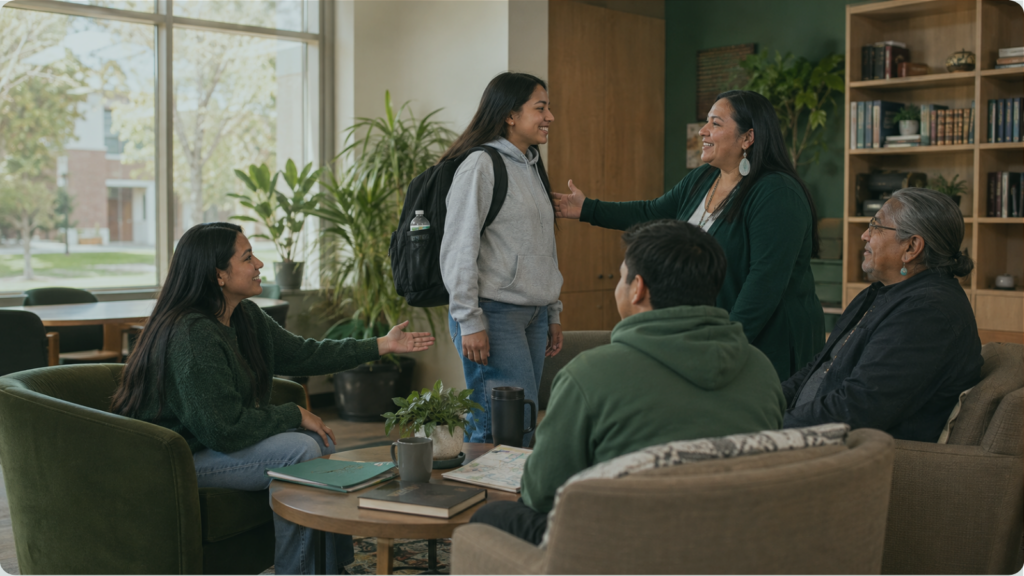
A Native student center can provide a place to gather, study, participate in cultural activities, receive guidance, and develop relationships with peers and staff. Staff members may also help students locate scholarships, communicate with other college offices, find mentors, and navigate challenges.
When exploring a support center, students should consider:
- Whether the center has dedicated full-time staff
- How frequently the space is open and used by students
- What academic, personal, cultural, and financial guidance is available
- Whether Native student organizations are active
- How the center connects students with Tribal Nations and local Native communities
Key takeaway: Look for a college with dedicated Native student staff and a welcoming space where students can build consistent relationships.
Some colleges invite Elders, artists, cultural teachers, and other knowledge keepers to spend time on campus. These programs provide opportunities for students to receive teachings, participate in cultural activities, and develop intergenerational relationships.
The names of these programs vary and may include:
- Elder-in-Residence or Visiting Elder programs
- Culture Bearer-in-Residence programs
- Auntie-in-Residence programs
- Artist-in-Residence programs
- Intergenerational circles and cultural workshops
Students should determine whether these opportunities are offered consistently or only during occasional events. Ongoing programs provide greater opportunities to form relationships and create a continuing circle of support.
Key takeaway: Explore colleges that provide recurring opportunities for students to connect with Elders, cultural teachers, and Native community members.
Living-learning communities bring students together through a shared cultural, academic, or personal interest. A Native-specific residential community can give students opportunities to live alongside Native peers and allies while participating in cultural and educational programming.
For example, the University of Minnesota Twin Cities offers the Ojibwe Immersion House, where students can strengthen their Ojibwe language skills through everyday use. Dartmouth College’s Native American House supports Native intellectual, social, cultural, and spiritual life.
Students may also want to learn whether housing policies support smudging and other cultural practices, whether gathering or ceremonial spaces are available, and whether students can prepare and share traditional foods.
Key takeaway: Consider whether the college provides living spaces where Native students can build community and practice their cultures as part of everyday campus life.
Bridge programs help students become familiar with college before the academic year begins. Students may move into campus housing early, learn how to navigate the college, register for classes, meet staff, and connect with other students.
Native-specific bridge programs may also incorporate cultural activities, family participation, community-building, and connections with Native staff, peers, Elders, and cultural teachers. These relationships can reduce uncertainty and help students begin college with an established support network.
Key takeaway: Research colleges that provide culturally responsive transition programs and continue supporting students beyond their first days on campus.
Providing culturally responsive college planning requires specialized knowledge and resources. Native students benefit when counselors help them look beyond traditional college-search factors and examine how a campus supports cultural identity, relationships, community, and belonging.
Cultural support should not be treated as an optional campus benefit. A Native student center, dedicated staff member, Elder-in-Residence program, living-learning community, or culturally responsive bridge program may become an important source of connection throughout a student’s college experience.
CollegeBound Journey helps school counselors, college counselors, educators, students, and families identify colleges that provide meaningful cultural support for Native students.
Use the CollegeBound Journey College Search to explore colleges through the cultural, academic, financial, and campus considerations that matter to Native students.
Explore the College Search