A college-going culture is not created through application deadlines, posters, or a single college night. For Native youth, it grows when students consistently see that higher education can honor who they are, strengthen their communities, and support the futures they envision.
Schools play an important role in shaping what students believe is possible. When college planning is culturally responsive, Native students are not asked to separate education from identity. Instead, they are invited to explore how their strengths, cultures, families, and community responsibilities can travel with them into higher education.
The following practices can help schools create a college-going culture in which Native youth feel represented, supported, and prepared to take their next steps.
Representation is an important foundation for a college-going culture. Native students need to see their identities reflected not only during Native American Heritage Month, but throughout the school year.
Schools can display information about Tribal Colleges and Universities, feature Native college students and graduates, recognize tribal nations represented within the school community, and incorporate Native voices into classroom and college-planning activities.
- Display tribal flags, Native artwork, and posters featuring Native graduates.
- Highlight colleges with Native student centers, tribal partnerships, and culturally grounded programs.
- Invite Native alumni, community members, and Elders to share their educational journeys.
- Recognize that Native students represent many distinct tribal nations, cultures, languages, and experiences.
- Ask students how they would like their cultures and communities represented.
These actions help students imagine college as a place where they can continue to grow without leaving their cultural identities behind.
Key takeaway: When culture is visible and valued, Native youth are more likely to see higher education as a place where they can belong.
Instead of asking only, “What do you want to be?” invite students to consider, “What gifts do you want to develop?” and “How could your education support the people, places, or issues that matter to you?”
College planning is often framed as an individual path toward personal success. For many Native students, however, education may also be connected to family, community, tribal sovereignty, cultural preservation, and service.
Counselors and educators can help students explore how different programs of study connect with community priorities. Teaching, healthcare, environmental science, language revitalization, social work, business, law, technology, and tribal governance are only a few possibilities.
- The personal strengths and cultural knowledge they already carry.
- Needs or opportunities they notice within their communities.
- College majors connected with their interests and responsibilities.
- Ways education can support both personal goals and collective well-being.
- Different postsecondary pathways—not just one definition of success.
This does not mean placing responsibility for solving community challenges on students. It means giving Native youth space to define success in ways that reflect their own values and aspirations.
Key takeaway: Connecting education with purpose helps college planning feel relevant, meaningful, and grounded in what matters to each student.
Students should not have to discover the college-planning process on their own. A college-going culture makes information visible, explains unfamiliar terms, and provides repeated opportunities to practice each step.
Begin college and career conversations before senior year. Students can explore their interests, learn about different types of colleges, compare admission requirements, investigate culturally supportive campus resources, and develop financial-aid knowledge over time.
- Grade-level college and career planning activities.
- Clear explanations of college terminology and application steps.
- Opportunities to explore two-year colleges, four-year colleges, TCUs, training programs, and other pathways.
- College visits that include conversations with Native students and campus support staff.
- Individual guidance for applications, essays, financial aid, and scholarships.
- Information about Native student organizations, cultural centers, mentorship, and community connections.
Students benefit when college planning is an ongoing process rather than a series of urgent tasks completed during senior year.
Key takeaway: College knowledge builds confidence when information is introduced early, revisited often, and connected to concrete next steps.
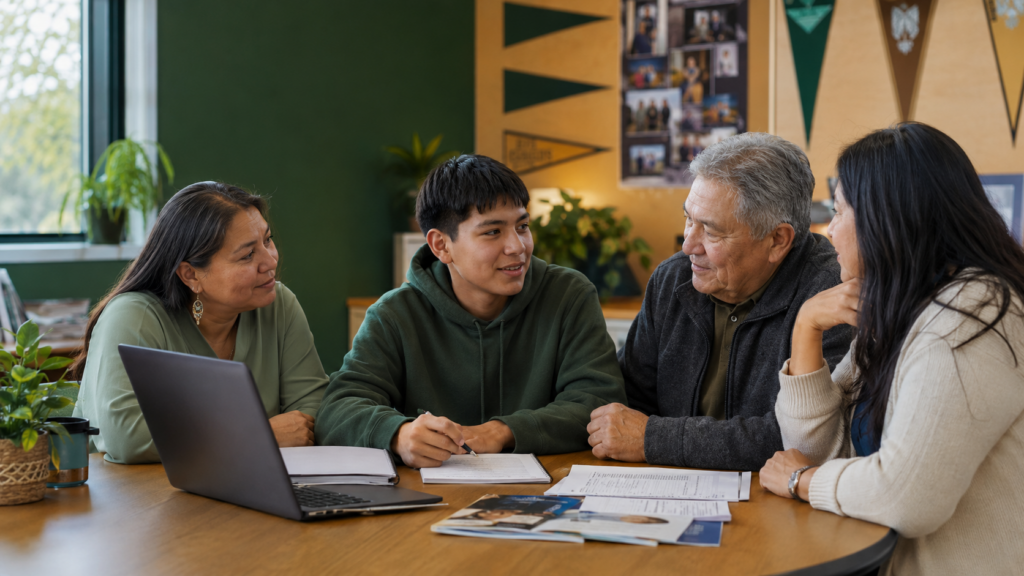
Families bring knowledge, experience, hopes, questions, and concerns to the college-planning process. Parents, grandparents, guardians, extended family members, and other trusted adults may all have important roles in supporting a student’s decisions.
Schools can strengthen these partnerships by creating welcoming and culturally respectful opportunities for families to learn about college options. Information should be shared clearly, without assuming that families already understand admissions, financial aid, or college terminology.
- College-planning events designed with Native families in mind.
- Financial-aid nights with time for individualized assistance.
- Clear explanations of FAFSA, scholarships, tribal funding, and tuition-waiver programs.
- Opportunities for families to identify their questions and priorities.
- Participation from tribal education staff and Native community partners.
- Flexible communication options that respect family schedules and preferences.
CollegeBound Journey’s family-night resources—including Native Family College Night and Family Financial Aid Night—are designed to encourage supportive, intergenerational conversations about education, culture, and the future.
Key takeaway: When families are welcomed as partners, students know they have a circle of support walking beside them.
Concerns about cost can cause students to decide that college is out of reach before they have explored their options. Schools can reduce this barrier by making financial-aid conversations a normal part of college planning.
Students and families need accurate information about the FAFSA, scholarships, tribal education funding, tuition-waiver programs, in-state tuition opportunities, work-study, and the actual cost of attendance.
It is also important to explain that financial support varies by college, state, tribal nation, program, and student eligibility. Students should be encouraged to verify current requirements directly with each funding source.
- Introducing financial-aid concepts before senior year.
- Helping families create the accounts and gather the documents they will need.
- Providing hands-on FAFSA completion support.
- Teaching students how to find and evaluate scholarship opportunities.
- Discussing tribal scholarships and funding with appropriate tribal education offices.
- Helping students compare financial-aid offers and remaining costs.
Key takeaway: Early and consistent financial-aid guidance helps students move from wondering whether college is affordable to understanding how they can build a realistic plan.
Trust cannot be created through a single event. It develops when students and families experience respect, consistency, honesty, and follow-through from school staff.
This is especially important because many Native families carry personal or intergenerational experiences with educational systems that harmed Native children, separated families, and devalued Indigenous languages and cultures.
Cultural humility asks educators to listen, recognize what they do not know, avoid treating one Native experience as universal, and remain accountable for how they work with students and communities.
- Learning and correctly pronouncing students’ names.
- Following through on commitments and communicating when plans change.
- Listening before deciding what students or families need.
- Attending community events when invited and appropriate.
- Building relationships with tribal education departments and Native-led organizations.
- Recognizing Native students as individuals rather than asking them to represent all Native people.
Key takeaway: Authentic relationships show Native youth and families that the school is prepared to walk with them—not simply direct them through a process.
A college-going culture recognizes the many steps students take along the way. Completing a college search, attending a campus visit, requesting a transcript, submitting the FAFSA, applying for a scholarship, or asking for help are all meaningful milestones.
Schools can recognize these moments while respecting students who prefer not to have their plans shared publicly. Celebrations should include the full range of postsecondary pathways and avoid suggesting that one type of institution represents greater success than another.
- Creating a college and career milestone display.
- Sharing student accomplishments with permission.
- Inviting Native graduates to speak with younger students.
- Hosting an inclusive senior decision or pathway celebration.
- Recognizing scholarship applications as well as awards.
- Celebrating persistence, preparation, and thoughtful decision-making.
Key takeaway: Recognizing progress helps students see college planning as a series of achievable steps rather than one overwhelming decision.
Creating a college-going culture for Native youth requires more than encouraging students to apply. It requires schools to build environments where identity is honored, families are welcomed, information is accessible, and relationships are grounded in trust.
When these practices are woven throughout the school experience, Native students receive a powerful and consistent message: higher education is possible, their goals matter, and their cultures belong wherever their journeys take them.
Explore CollegeBound Journey® tools designed to help counselors and educators support Native students throughout the college-planning process.
Explore Counselor & Educator Resources