The CollegeBound Journey® Career Cluster Assessment for Native American Students offers a culturally responsive starting point for that exploration. Designed for students in grades 8–12, the assessment helps young people identify career areas that reflect what they enjoy, what they do well, and what matters to them.
Students can use their results to begin exploring possible occupations, educational pathways, college majors, technical training programs, and community-based opportunities. The goal is not to decide on one permanent career. Instead, the assessment helps students develop language for their interests and identify meaningful directions to explore.
Many traditional career assessments focus primarily on personal interests and workplace preferences. Those questions are useful, but they may not capture the full range of considerations that influence a Native student’s future.
Students may also think about relationships, cultural identity, connections to place, responsibilities to family, community needs, financial stability, leadership, and the possibility of remaining close to—or returning to—their home community.
Culturally responsive career planning creates room for all of these considerations without assuming that every Native student shares the same goals. Some students may want careers directly connected to their Tribal communities. Others may envision careers in urban settings, across industries, or in places far from home. Many will combine personal, professional, cultural, and community priorities in ways that are uniquely their own.
The assessment connects students’ responses to the updated 14 career clusters. Within those clusters, students can consider a broad range of occupations and the different ways those careers may serve individuals, organizations, communities, and Native nations.
Students might explore careers involving land stewardship, water protection, renewable energy, environmental science, agriculture, forestry, wildlife management, or traditional ecological knowledge.
Possible pathways include nursing, medicine, behavioral health, public health, social services, community wellness, rehabilitation, and culturally grounded approaches to care.
Students may be drawn to teaching, school counseling, language revitalization, curriculum development, educational leadership, youth programming, or Tribal education.
Students can explore business ownership, Tribal enterprise, finance, hospitality, nonprofit leadership, economic development, project management, or organizational leadership.
These are only a few examples. Native professionals contribute across every career cluster—from the arts and communications to construction, technology, public service, law, transportation, advanced manufacturing, and scientific research.
Rather than asking students to select a career before they are ready, the assessment encourages them to consider the kinds of work, responsibilities, and problems that interest them. Students respond to prompts such as:
Can you see yourself helping preserve Indigenous building knowledge and techniques?
Would you enjoy designing systems that support clean water or sustainable energy?
Can you imagine teaching, mentoring, or advocating for Native youth?
Would you like to help a business, organization, or Tribal enterprise grow?
Questions like these help students think beyond familiar job titles. A student may discover that an interest in caring for others can lead to several healthcare, education, or human-service careers. Another may recognize that an interest in land and water can connect to environmental science, engineering, agriculture, policy, or natural-resource management.
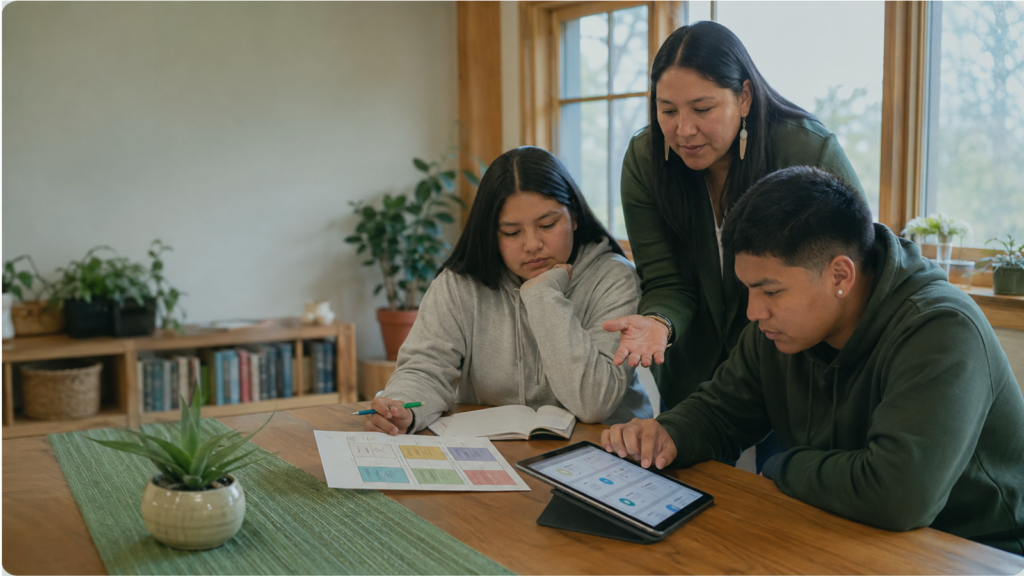
An assessment result is most helpful when it becomes the beginning of a conversation. After students identify their strongest career clusters, educators and families can help them explore:
- Occupations included within their highest-scoring clusters
- The daily responsibilities associated with different careers
- Education, training, licensing, or certification requirements
- College majors and technical programs connected to those careers
- Local and Tribal community needs or employment opportunities
- Job-shadowing, mentoring, internship, and summer enrichment experiences
- How a career may support the student’s personal, family, cultural, or community goals
Students should also be encouraged to explore more than their highest-scoring area. Interests develop over time, and many careers bring together skills from several clusters. Results offer direction—not a limit on what a student can become.
Educators, counselors, Indian Education staff, Tribal education professionals, and families can deepen the experience by asking students:
- Which result felt most like you?
- Was there a result that surprised you?
- Which careers would you like to learn more about?
- What strengths or experiences could you bring to those careers?
- What kind of education or training might you need?
- Who could help you learn more about this pathway?
- How could this work support the future you want for yourself?
These conversations help students connect assessment results to real experiences, supportive relationships, and manageable next steps.
Once students identify possible career areas, they can begin looking for colleges and programs that support their academic and cultural priorities. The CollegeBound Journey Native American College Search helps students and those supporting them explore colleges based on academic opportunities, campus experiences, cultural support, and financial support.
This connection between career exploration and college planning can make the process feel more purposeful. Instead of asking only, “Where should I go to college?” students can begin asking, “What do I want to learn, who do I want to become, and what kind of environment will help me move toward that future?”
The Career Cluster Assessment for Native American Students includes a printable student assessment, scoring guidance, and reflection activities that help students identify potential career pathways aligned with the 14 career clusters.
It can be used during individual counseling, classroom career lessons, advisory periods, college-readiness programming, Tribal youth programs, or family career-planning conversations.
The assessment is also included among CollegeBound Journey® career-planning resources available to participating schools and organizations.