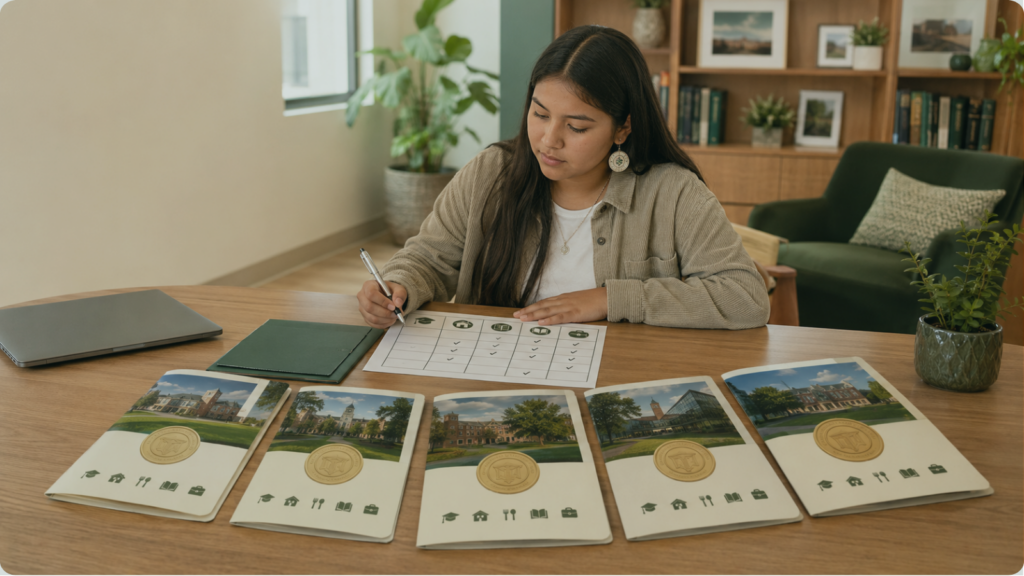
Five college and career-connected funding opportunities that can significantly reduce tuition costs for eligible Native American and Alaska Native students.
A full-tuition opportunity can transform a student’s college options—but the name of an award rarely tells the entire story.
Some programs pay tuition directly. Others cover the remaining tuition balance after federal, state, Tribal, or institutional aid has been applied. A few may also provide support for fees, books, housing, or employment.
The five opportunities below illustrate the range of funding that may be available to Native students. Because award amounts, eligibility requirements, application procedures, and available funding can change, students should always confirm current information with the scholarship provider.
The terms full tuition, last-dollar tuition, and full cost of attendance do not mean the same thing. Students should understand these differences before estimating how much they may need to pay.
Covers the institution’s tuition charges. Fees and living expenses may not be included.
Pays the remaining eligible tuition balance after certain grants and scholarships have been applied.
May include tuition, required fees, housing, meals, books, transportation, and other approved expenses.
Truman State University’s First Americans Scholarship was established through the Truman State University Foundation to support a student with Native American ancestry. The endowed scholarship was created by Maj. Gen. John V. Cox and Patricia McMichael Cox.
The scholarship is designed as a renewable award that provides full-tuition and room-and-board support. Because a limited number of students may receive the award, applicants should contact Truman State University to confirm current availability and application procedures.
- Students with documented Native American ancestry
- Students demonstrating financial need
- First-generation college students
- Students preparing to attend Truman State University
- Full tuition
- Room and board
- Renewable scholarship support
Augsburg University’s American Indian Recognition Full Tuition Program is available to eligible new first-year and transfer undergraduate students pursuing their first bachelor’s degree. The program does not limit eligibility to Minnesota residents.
Augsburg defines eligible American Indian students as enrolled members of federally recognized Tribes or Alaska Native Villages, as well as qualifying first- or second-generation descendants. The university also provides an alternative written-response pathway related to a student’s interest in American Indian history, culture, challenges, and issues.
- New first-year or transfer undergraduate student
- Pursuing a first bachelor’s degree
- FAFSA and required documents submitted annually
- Required eligibility documentation or written responses
- Remaining tuition and fees for eligible students under the published income threshold
- Unmet tuition need for eligible students above that threshold
- Renewable for up to eight full-time fall and spring terms
Augustana University’s Prairie Sage Scholarship Endowment was created to support Native American and First Nations students whose academic interests can help preserve and foster Native cultures, stories, arts, languages, and ways of knowing.
The endowment currently supports a full-time Native American student at Augustana. The published long-term goal of the scholarship’s donors is for the endowment to grow enough to provide full-tuition support to eligible students.
- Anthropology
- Art, history, or literature
- Journalism, law, or language
- Philosophy, religion, and related storytelling disciplines
- Supports a full-time Native American student
- Promotes the preservation of Native culture and art
- Has a stated long-term goal of providing full tuition
The USDA 1994 Tribal Scholars Program combines college funding with paid work experience and a potential career pathway within the United States Department of Agriculture.
Selected students pursue bachelor’s degrees in agriculture, food science, natural resource science, or related fields. Their educational pathway begins at a participating Tribal College or University and may continue at another institution of higher education.
- Attend, plan to attend, or recently graduated from a Tribal College or University
- Pursue an eligible bachelor’s degree
- Remain in good academic standing
- Complete the required USDA application process
- Full tuition
- Required fees and books
- Paid employment and employee benefits
- Up to four years of renewable support
- Potential permanent federal employment
Salt Lake Community College offers the Native American Community Scholars & Fellowship Program to support eligible Native students attending Salt Lake Community College or Salt Lake Technical College.
The program can cover tuition costs for enrollment of up to 18 credit hours. Students apply through ScholarshipUniverse and must reapply each year to be reconsidered for funding.
- Admitted SLCC or Salt Lake Technical College student
- Enrolled in an eligible course or program
- Meets the program’s current Tribal eligibility requirements
- Completes the annual scholarship application
- Tuition costs for up to 18 credit hours
- Available to qualifying degree, certificate, and certain non-degree students
- Annual opportunity for reconsideration
Students and families should request a complete explanation of how an award will interact with other financial aid. Helpful questions include:
- Does the award cover tuition only or tuition and required fees?
- Is it awarded before or after federal and state grants?
- Are housing, meals, books, and transportation included?
- Is the award renewable, and for how many semesters?
- What GPA, credit-load, or academic progress must be maintained?
- Is Tribal enrollment or descendancy documentation required?
- Are there residency, income, major, or career requirements?
- Is a separate application required after college admission?
Even when tuition is completely covered, a student may still need a plan for fees, housing, food, books, technology, transportation, health insurance, and personal expenses. Compare each award with the college’s complete cost of attendance—not tuition alone.
Full-tuition programs are valuable, but they may be competitive, limited, or tied to specific colleges, Tribes, locations, majors, or career pathways. Students should continue applying for other sources of funding even after identifying a promising tuition program.
A strong funding plan may combine institutional scholarships, Tribal higher-education funding, state grants, tuition waivers, Native-specific scholarships, local awards, federal financial aid, and work-based opportunities.
CollegeBound Journey’s Scholarship Search helps students explore Native-specific scholarships using factors such as Tribal enrollment, descendancy, affiliation, educational interests, and other eligibility requirements.
Explore the Scholarship Search